Energy Meters: A Complete Guide
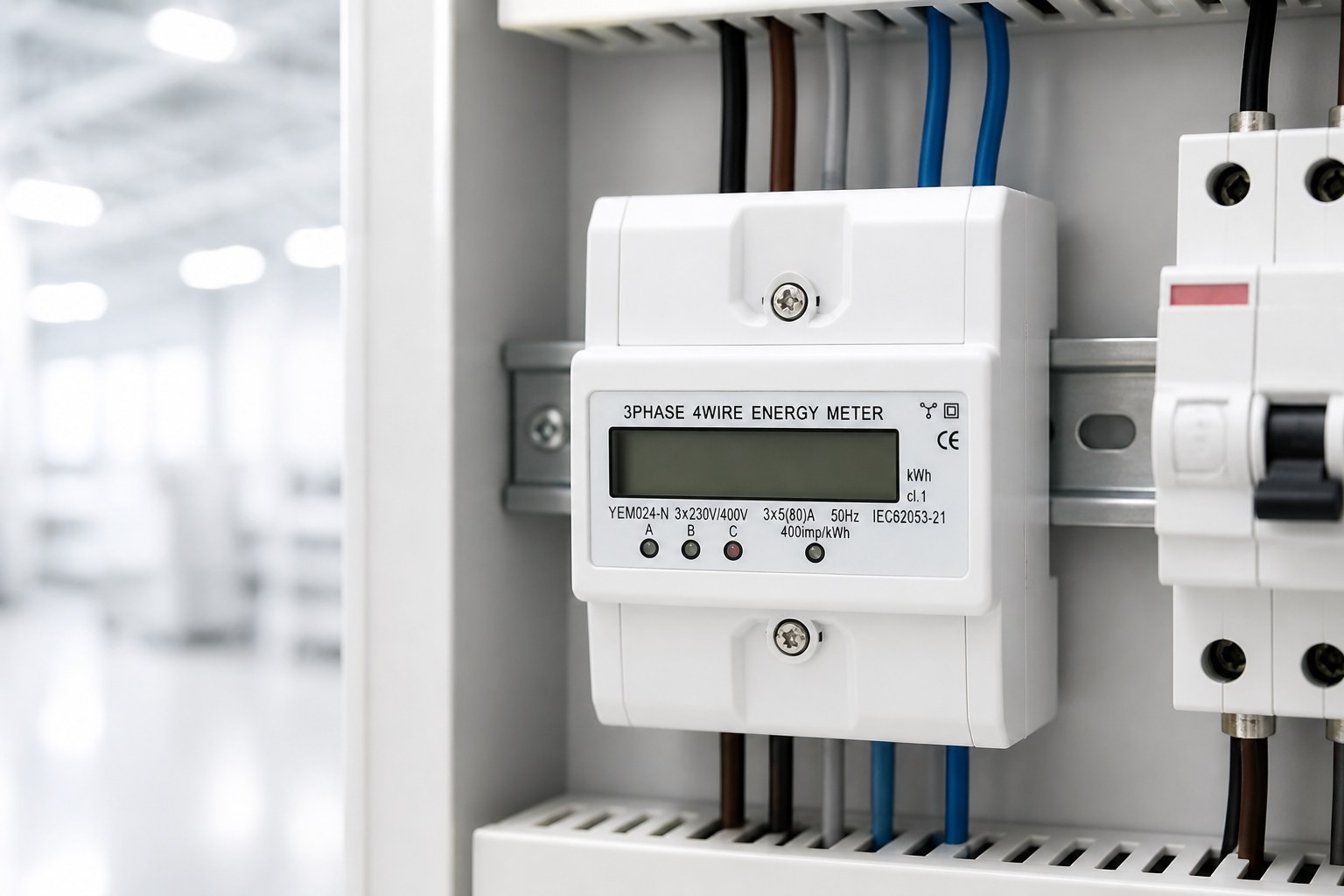
Energy meters play a crucial role in the control and management of energy, offering key information for improving energy efficiency. Energy meters enable the trading of electricity and billing processes for both end users and businesses. Through energy meters, monitoring and energy consumption optimization can be achieved, from a single apartment to a whole factory, a solar plant, or a utility network.
Metrology regulations such as the Measuring Instruments Directive (MID) in Europe and ANSI C12 in North America secure the accuracy, performance, and trustworthiness of metering data, providing a safeguard for both end users and system providers. This guide explains what energy meters are, why you need them, how they work, the main energy meter types, and what to look for when choosing one.
What Is an Energy Meter?
An energy meter is a device designed to measure and monitor electrical energy consumption or production. Energy metering devices measure voltage and current, calculate active (and often reactive) energy, and record it on a register or display. Depending on the model, they may also include data logging, communication interfaces (such as RS485/Modbus or pulse output), and integration capabilities with control systems for real-time monitoring.
Energy meters play a crucial role in billing, efficiency assessment, and overall system optimization. Whether the goal is accurate tenant billing, utility revenue metering, or tracking the output of a solar installation, the meter is the point of truth for how much electricity was actually used or generated.
Why Use an Energy Meter?
Using an energy meter serves several important purposes:
- Billing and cost management: Energy meters accurately measure the electricity consumed or supplied, which is essential wherever energy is traded, billed to tenants, or settled between utilities and customers.
- Efficiency monitoring: They let operators and building owners monitor the efficiency of electrical systems and optimize energy consumption month by month.
- Load management: Meters help track demand, identify peak usage, and manage loads such as EV chargers, HVAC, and production equipment.
- System optimization: Reliable consumption data supports decisions about equipment, tariffs, and energy-saving investments.
- Environmental impact assessment: Energy metering solutions help quantify energy use and carbon footprints for reporting and sustainability programs.
- Regulatory compliance: Energy meters help operators and service providers comply with regulations related to energy consumption, billing accuracy, and environmental reporting.
How Does an Energy Meter Work?
An energy meter works by continuously sampling the voltage and current of the circuit it monitors and computing the energy consumed. The measurement principle is straightforward:
- Voltage and current sensing: The meter reads the line voltage and the load current. For higher currents, the meter is paired with current transformers so the sensing element works in a safe range.
- Energy calculation: The meter multiplies voltage and current over time to compute active energy (kWh) and, in three-phase or smart models, reactive energy (kvarh), power factor, demand, and other parameters.
- Register and display: The result is stored on an electromechanical register or an electronic memory and shown on the display, with pulse or communication outputs for remote reading.
Modern electronic meters add features such as multi-tariff (TOU) registers, load profiles, tamper detection, and RS485/Modbus communication. When the load exceeds the meter’s direct rating, a correctly sized current transformer extends the measurement range without replacing the meter.
Main Types of Energy Meters
Energy meter types are usually defined by their mounting form, their measurement principle, and the features they carry. Most installations fall into one of these families:

Single-Phase DIN Rail Energy Meter
Compact DIN rail kWh meter with LCD display (model YEM015SD, 230 V, 5(30) A) for apartments, small shops, and sub-metering.
Three-Phase Digital Energy Meter
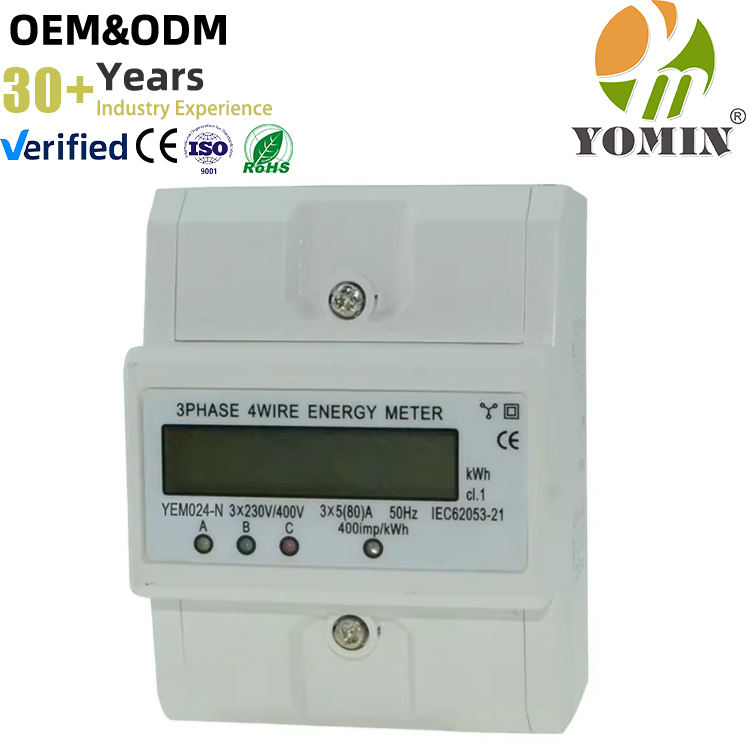
Three-phase four-wire LCD meter (model YEM024-N, 3×230/400 V, 3×5(80) A, IEC 62053-21) for factories, malls, and solar plants.
Electromechanical kWh Meter
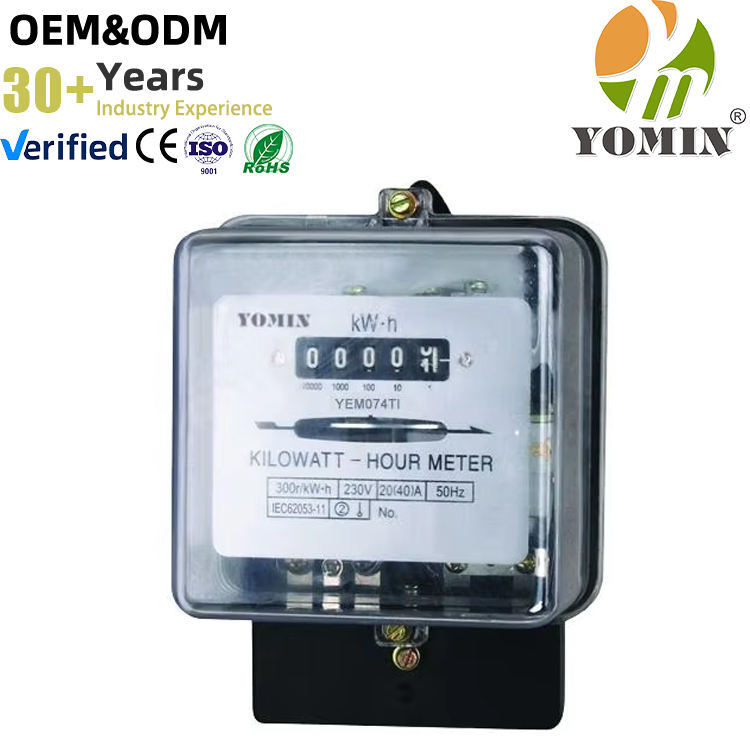
Induction-type single-phase meter (model YEM074TI, 230 V) with analog cyclometer register, proven for decades of reliable service.
Mechanical Front-Board Meter
Classic single-phase two-wire mechanical meter for front-board mounting, widely used for residential revenue metering.
Beyond these, the same energy meter family includes smart prepaid meters with GPRS/Wi-Fi communication, RS485 Modbus meters for energy management systems, and meter accessories such as terminal blocks and seals. The right energy meter type depends on the supply (single or three phase), the current range, and the features the application requires.
5 Advantages of Using a Quality Energy Meter
Quality energy metering solutions deliver advantages that go beyond simply counting kWh:
- High precision and accuracy: Class 1.0 and Class 0.5S meters per IEC 62053 keep billing fair and monitoring reliable, even at low loads.
- Wide range of applications: Meters can be used across homes, commercial buildings, factories, solar installations, EV charging, and utility networks.
- Compact and robust design: DIN rail meters fit standard distribution boards and are built to operate reliably in demanding environments.
- Data trustworthiness: Electronic meters protect registers against tampering and provide auditable readings for billing and compliance.
- Long-term reliability: Meters are designed for decades of service with minimal maintenance, lowering the total cost of ownership.
Where Are Energy Meters Used?
Energy metering makes a measurable difference in many settings:
- Utility and residential billing: Single-phase and three-phase meters measure consumption for accurate monthly billing, including prepaid and multi-tariff schemes.
- Commercial buildings and facilities: Sub-meters allocate energy between tenants, floors, or departments and feed energy management systems via RS485/Modbus.
- Solar and distributed energy: Bi-directional meters track both consumption and export, enabling net metering for solar PV systems and storage.
- Industry and infrastructure: CT-connected meters measure large loads such as pumps, compressors, furnaces, and EV charging stations.
Standards and Compliance for Energy Meters
Because energy meters support legal billing, they are regulated by metrology standards. The most common references are IEC 62053-21 (class 1 and 2 active energy), IEC 62053-22 (class 0.5S/0.2S), IEC 62053-23 (reactive energy), and IEC 61036 for electronic meters. In Europe, MID (Directive 2014/32/EU) is required for meters used in billing and trade; in North America, ANSI C12 and utility pattern approvals apply.
Yomin Electric meters are manufactured to these standards with CE and RoHS compliance, and our engineering team works with customers to confirm the local metrology requirements before supply, so the meters you install are accepted for billing from day one.
Q&A
What is an energy meter?
Short answer: An energy meter is a device that measures and records electrical energy consumption or production in kilowatt-hours (kWh). It may also measure demand, reactive energy, and other parameters, and it can include communication features for remote reading and monitoring.
Why should I install an energy meter?
Short answer: Energy meters enable accurate billing, efficiency monitoring, load management, system optimization, environmental reporting, and regulatory compliance. Without a meter, energy use is estimated rather than measured, which makes billing and improvement decisions unreliable.
What is the difference between a single-phase and a three-phase energy meter?
Short answer: A single-phase meter measures a two-wire 120–240 V supply, typical for homes and small shops. A three-phase meter measures a three-phase supply (3P3W or 3P4W), typical for factories, commercial buildings, and larger loads. Choose the meter that matches the supply feeding the circuit you want to measure.
What accuracy class do I need?
Short answer: Class 1.0 is the standard for most residential and commercial billing. Use Class 0.5S or 0.2S for utility boundary metering, tenant allocation, and energy trading. Higher accuracy classes cost more, so match the class to the billing or monitoring requirement.
Can an energy meter communicate with my energy management system?
Short answer: Yes, if the meter includes a communication interface such as RS485/Modbus RTU, pulse output, or wireless connectivity. RS485/Modbus is the most common choice for integration with BMS, energy dashboards, and data concentrators, and it works even when the network is offline.
Need Help Choosing the Right Product?
Our engineers can recommend the exact model, rating and configuration for your project. Tell us your requirements and get a factory-direct quote within 24 hours.