Fuse and Protection Selection Guide
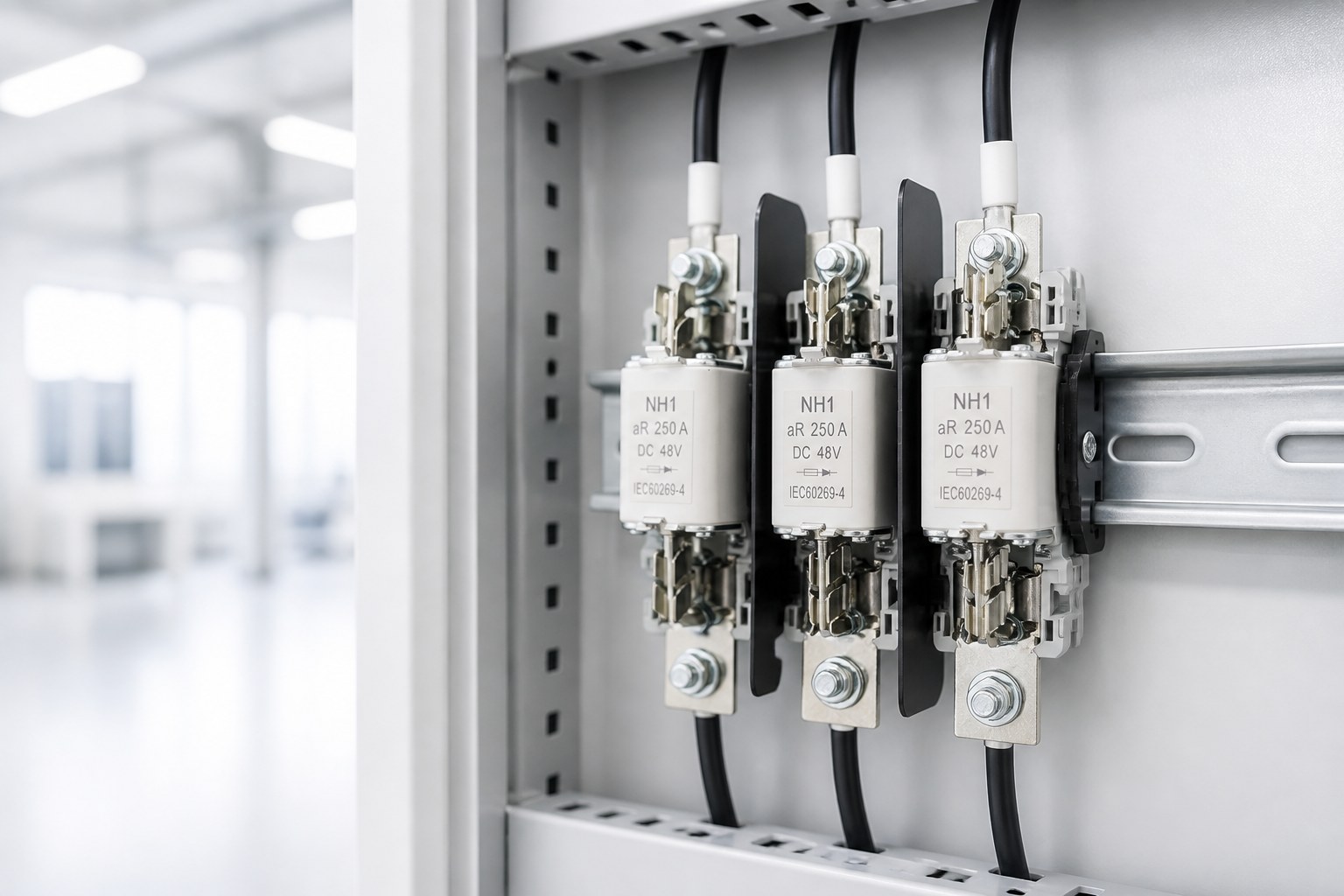
Fuses are the oldest and still one of the most reliable forms of overcurrent protection: a calibrated element that melts and clears a fault, protecting cables, equipment, and people. Choosing the right fuse is about five ratings: type, voltage, current, breaking capacity, and time-current behavior, plus coordination with the rest of the installation. This fuse and protection selection guide explains each one and gives you a repeatable fuse selection process.
Step 1: Identify the Circuit and the Fuse Type
Fuse types are defined by their application and by the IEC utilization category printed on the body. The two letters tell you what the fuse protects:
| Fuse type | Meaning | Typical use |
|---|---|---|
| gG | General-purpose, full-range breaking | Cable and installation protection, distribution boards |
| aM | Motor circuit, partial range | Motor starters and drives (with overload relay) |
| gR / aR | Semiconductor protection | Rectifiers, inverters, drives, power electronics |
| gPV | Photovoltaic protection | Solar strings and combiners |
| gTr | Transformer protection | Distribution transformers |
For general panel and cable protection choose gG. For motor circuits choose aM fuses plus an overload relay. For DC circuits, including solar, choose a DC-rated fuse with the correct DC voltage rating.
Step 2: Match the Voltage Rating
The fuse voltage rating must be equal to or higher than the system voltage, both AC and DC. A fuse rated 500 V AC on a 230 V circuit is fine; the reverse is not. On DC circuits, voltage ratings are lower than AC ratings for the same fuse body because DC arcs are harder to interrupt. Never substitute an AC-only fuse into a DC circuit without checking the DC rating.
Step 3: Set the Current Rating for the Cable, Not the Load
Fuse sizing starts with the protected cable or equipment, not with the load you hope to run. The rule is simple:
- The fuse rated current should be greater than or equal to the load current.
- The fuse rated current should be less than or equal to the cable’s ampacity (current-carrying capacity).
- For continuous loads, apply the standard margin: fuse rating about 1.1–1.25× the continuous load, and check the cable ampacity covers it.
Example: a circuit drawing 16 A on a cable rated 25 A would normally use a 20 A gG fuse: above the load, below the cable rating. Picking a fuse by load alone can leave the cable unprotected; picking one by the breaker size alone can nuisance-trip.
Step 4: Verify the Breaking Capacity
Breaking capacity (Icn) is the maximum fault current the fuse can safely interrupt. It must be higher than the prospective short-circuit current at the point of installation. Typical values are 50 kA, 80 kA, or 100 kA for low-voltage industrial fuses. If the fault level at the board exceeds the fuse’s breaking capacity, the fuse may burst instead of clearing the fault. Check the short-circuit level with the utility or a fault study, then select a fuse with a higher breaking capacity.
Step 5: Check the Time-Current Characteristic
The time-current curve shows how long the fuse takes to operate at each level of overcurrent. It determines two practical things:
- Inrush immunity: Motors, transformers, capacitors, and lamp banks draw high starting current. The fuse must hold long enough to pass the inrush without aging or blowing.
- Fault discrimination: A downstream fuse must clear a fault before the upstream fuse or breaker, so only the faulty branch is lost.
For motor circuits, use aM fuses whose curve tolerates starting current; for general distribution, gG fuses coordinate cleanly with downstream devices when the ratings are spaced correctly (commonly a ratio of about 1.6× between adjacent fuse ratings at the same point).
Step 6: Choose the Physical Form
The fuse form must fit the holder or switchgear:
| Form | Size | Where used |
|---|---|---|
| Cartridge (cylindrical) | 10×38, 14×51, 22×58 mm | Distribution boards, small industrial panels |
| NH (knife-blade) | NH00–NH4 | Industrial switchboards, high-current feeders |
| Blade/automotive | Standard ATO/MINI | Vehicles, DC circuits |
| Diazed / bottle | D01–DIII | Older European domestic panels |
Match the form to the existing holder or specify the holder together with the fuse so the rated current and breaking capacity of the assembly are guaranteed.
Step 7: Plan Coordination and Spares
Electrical protection selection is not complete until the fuses coordinate with upstream breakers and downstream devices. Sketch the one-line diagram, mark the fault levels, and confirm each level clears before the one above it. Finally, stock spares of the exact ratings used: a fuse that is replaced with a wrong rating is a safety hazard, not a convenience.
When the installation includes metering, protect the meter circuits properly and confirm the CT secondary is fused or shorted as required. For complete protection packages, browse the fuses and protection range at Yomin Electric; for metering and monitoring around the protected board, an energy meter installed downstream gives you the load data to confirm the fuse selection over time.
Fuse Selection Checklist
| Parameter | Question to answer | Example result |
|---|---|---|
| Type | Circuit and load class | gG for cables, aM for motors |
| Voltage | System AC/DC rating | 500 V AC / 250 V DC |
| Current | Load vs cable ampacity | 20 A on 25 A cable |
| Breaking capacity | Prospective fault level | ≥50 kA at the board |
| Time-current | Inrush and discrimination | aM for motor starts |
| Form | Holder and switchgear | 22×58 mm gG cartridge |
| Coordination | Upstream/downstream clear | 1.6× rating spacing |
Run the checklist top to bottom for every circuit and you will avoid the two most common failures: fuses that blow on startup and fuses that are too big to protect the cable. If you need help with a specific board or a custom protection package, send us the load list and the one-line diagram and our engineers will confirm the correct ratings from the fuse and protection product line.
Q&A
What size fuse do I need for my circuit?
Short answer: Choose a fuse rated at or above the continuous load current (typically 1.1–1.25× load) and at or below the cable ampacity. For a 16 A load on a 25 A cable, a 20 A gG fuse is the normal choice. Confirm the voltage rating and breaking capacity for the installation point.
What is the difference between gG and aM fuses?
Short answer: gG (general-purpose) fuses protect cables and installations and clear the full overcurrent range. aM (motor) fuses protect motor circuits and tolerate starting inrush, but they cover only higher overcurrents and must be paired with an overload relay for low-level protection.
Why do fuses keep blowing on motor startup?
Short answer: The fuse is probably too small for the starting current or it is a gG type in a motor circuit. Motors draw several times rated current at start. Use an aM fuse sized for the motor or check that the fuse rating accounts for the inrush duration.
What does breaking capacity mean and why does it matter?
Short answer: Breaking capacity is the maximum fault current the fuse can safely interrupt. It must be higher than the prospective short-circuit current at the fuse location. If it is lower, the fuse cannot clear a full short circuit safely. Typical industrial values are 50–100 kA.
Can I use the same fuse for AC and DC circuits?
Short answer: Not automatically. DC arcs are harder to interrupt, so a fuse’s DC voltage rating is usually lower than its AC rating. Check the DC rating printed on the fuse or datasheet and use DC-rated types (for example gPV for solar strings) on DC circuits.
Need Help Choosing the Right Product?
Our engineers can recommend the exact model, rating and configuration for your project. Tell us your requirements and get a factory-direct quote within 24 hours.