The Influence of Shape and Winding Density on Rogowski Coil Accuracy and Sensitivity
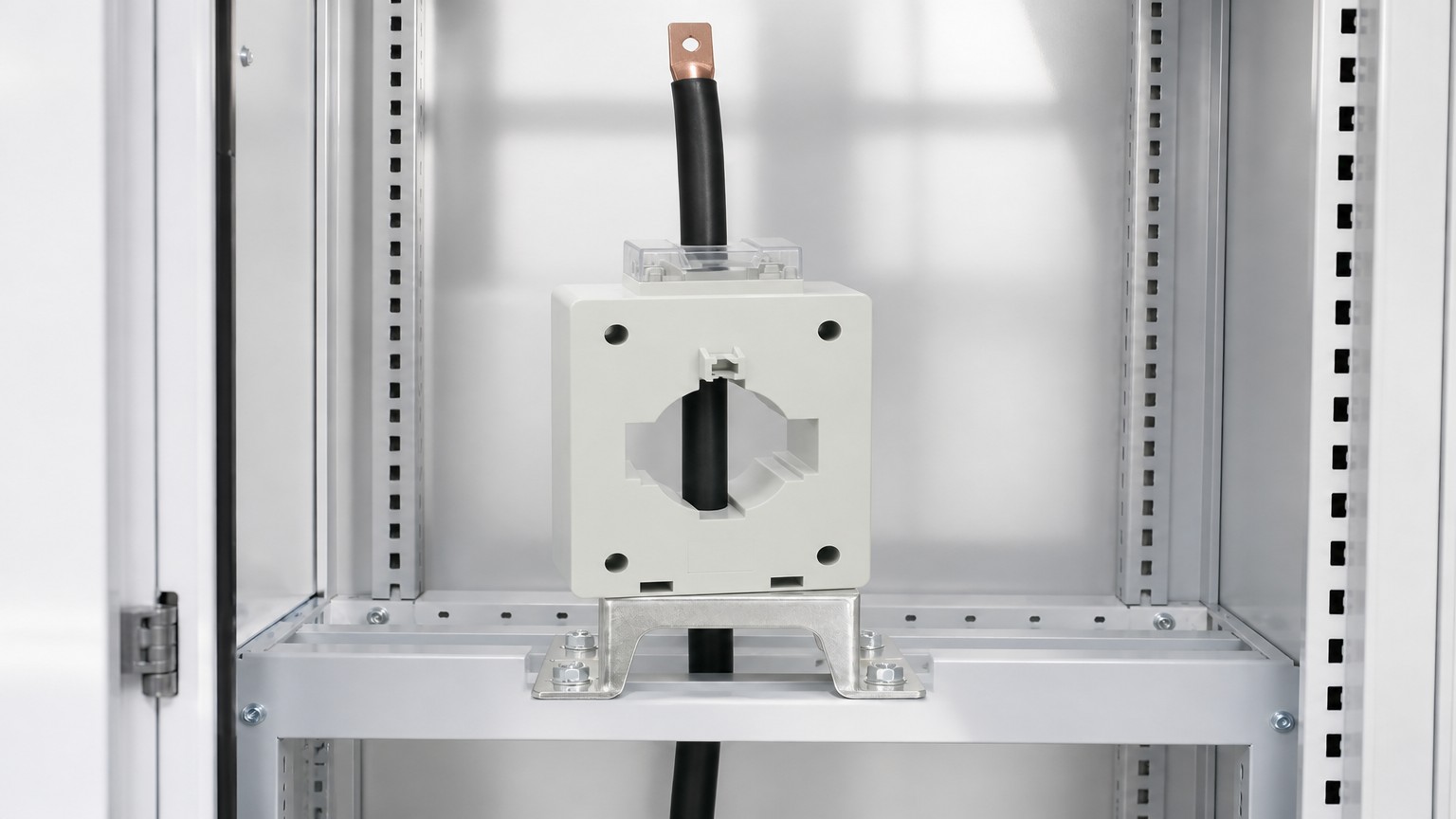
Rogowski coils are widely used for measuring alternating currents due to their flexibility, wide frequency response, and non-intrusive design. Unlike traditional current transformers, a Rogowski coil produces an output voltage proportional to the rate of change of current in a conductor, which requires careful design and signal processing for accurate measurement. Among the factors that significantly affect the performance of a Rogowski coil, the coil’s shape and winding density play critical roles in determining both accuracy and sensitivity.
The role of coil shape
The physical shape of a Rogowski coil influences how effectively it couples with the magnetic field generated by the current-carrying conductor. Coils are commonly designed in circular, rectangular, or flexible toroidal forms, each with specific advantages and potential drawbacks.
Circular coils
Circular Rogowski coils provide the most uniform magnetic coupling when surrounding a conductor with a compatible geometry. The symmetry ensures that the magnetic flux is evenly distributed throughout the coil turns, minimizing measurement errors caused by flux imbalance. Circular coils are easier to calibrate and typically deliver the highest accuracy in controlled installations.
Rectangular or irregular coils
Rectangular coils are often used in situations where conductors are large or arranged in non-circular configurations, such as busbars in switchgear panels. While these coils offer installation flexibility, the uneven distribution of magnetic flux can introduce slight measurement inaccuracies. Proper design and calibration are essential to compensate for geometric effects.
Flexible coils
Flexible or split-type coils, resembling a rope, allow easy installation around irregular or oversized conductors. They are especially useful in retrofit or temporary measurement applications. However, maintaining uniform turn spacing and perfect closure of the loop can be challenging, which may reduce both sensitivity and accuracy if not carefully managed.
The impact of winding density
Winding density, defined as the number of turns per unit length of the coil, directly affects the voltage output and sensitivity of a Rogowski coil. Since the induced voltage is proportional to the number of turns and the rate of change of current, winding density determines the coil’s ability to detect both low and high currents effectively.
- High winding density — increases induced voltage and sensitivity, ideal for small currents and high-frequency transients, provided the winding stays uniform.
- Low winding density — weaker signals and reduced sensitivity; usable for high-current applications but poor for subtle variations.
Uniform winding is crucial. Each turn must contribute equally to the induced voltage so the output stays linear and predictable. Non-uniformity produces measurement errors, particularly when integrating the voltage to reconstruct the current waveform.
Combined effects on performance
- Linearity — uniform flux coupling and consistent winding keep output proportional to current change.
- Sensitivity — higher winding density amplifies the signal.
- Bandwidth — design affects how accurately high-frequency transients are captured.
- Spatial accuracy — deviation from ideal shape makes readings sensitive to conductor position.
Rogowski coil vs current transformer
| Property | Rogowski coil | Current transformer |
|---|---|---|
| Core | Air core (non-saturating) | Iron core (can saturate) |
| Output | Voltage proportional to di/dt | Current (5 A / 1 A) |
| Flexibility | Flexible, fits large conductors | Fixed size, needs disconnection to install |
| Best for | Wide range, high-current, transient measurement | Standard metering and protection |
FAQ
Why is shape matching important?
The closer the coil conforms to the conductor geometry, the more uniform the flux coupling — and the more accurate the measurement.
Does more winding always mean better accuracy?
More turns increase sensitivity, but only if the winding is uniform; uneven windings introduce errors.
When should I choose a Rogowski coil over a CT?
For large or irregular conductors, retrofits without disconnection, and measurements requiring wide frequency response.
Final Thoughts
The shape and winding density of a Rogowski coil are fundamental determinants of measurement accuracy and sensitivity. By optimizing both physical geometry and winding configuration, the full potential of Rogowski coil technology can be realized — from industrial machinery monitoring to power system diagnostics. Yomin Electric’s current sensing range includes transformers and coils for these applications.
Need Help Choosing the Right Product?
Our engineers can recommend the exact model, rating and configuration for your project. Tell us your requirements and get a factory-direct quote within 24 hours.