Understanding How Energy Meters Work and Why It Matters for Your Home or Business
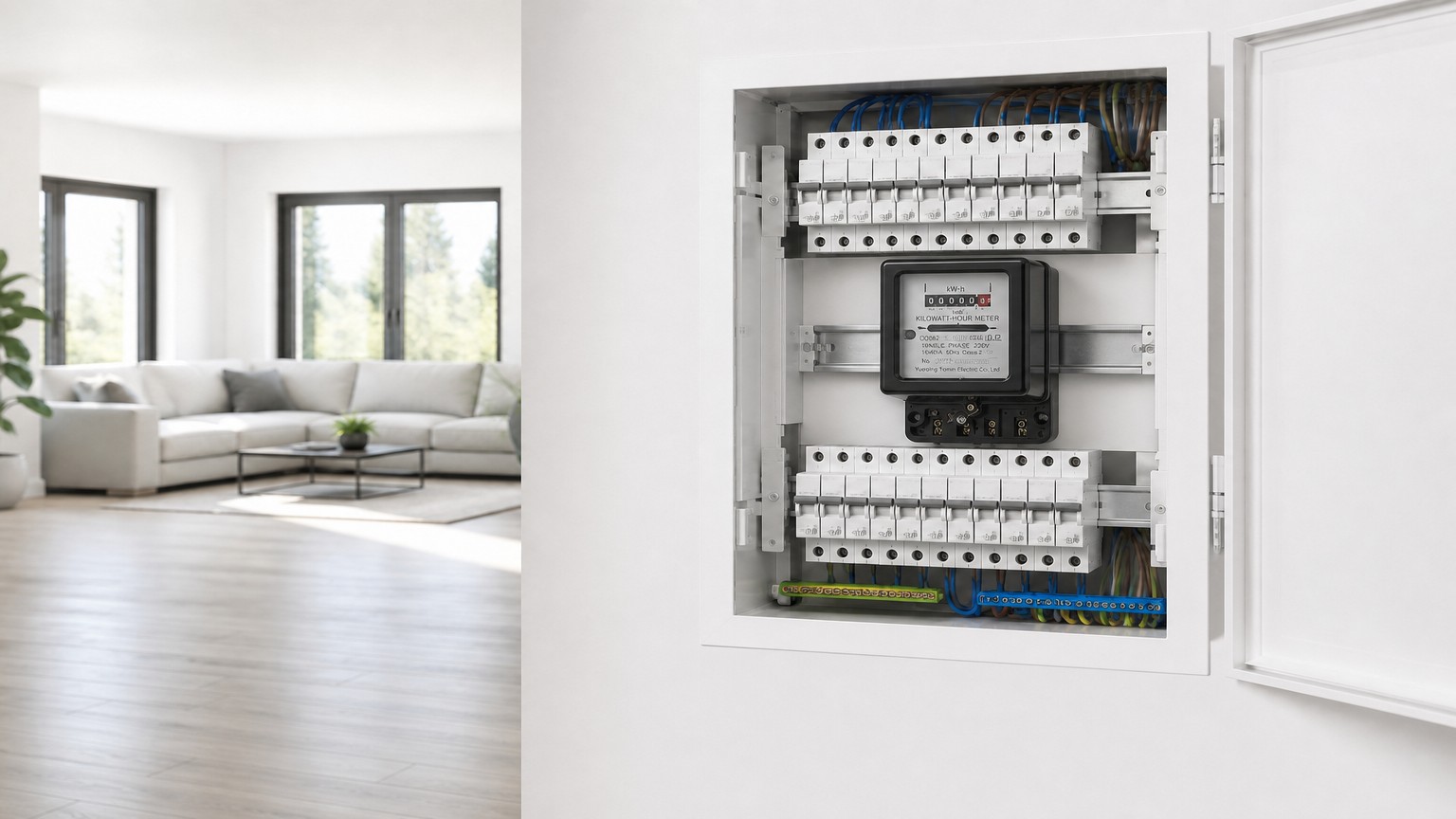
An energy meter is the device that tells you exactly how much electricity you consume. Whether it sits on a home wall, inside a commercial switchboard, or in a utility network, its job is the same: measure energy in kilowatt-hours (kWh) so consumption can be tracked, billed, and optimized. Understanding how energy meters work helps homeowners and businesses control costs, verify savings, and choose the right metering solution.
How an energy meter measures electricity
Electrical power is the product of voltage and current. An energy meter samples both continuously, multiplies them to obtain instantaneous power in watts, and integrates power over time to calculate energy in kWh. Electromechanical meters do this with a spinning disk; electronic meters do it with digital sampling and an integrated circuit — faster, more accurate, and more stable.
Key components inside a meter
- Current sensing — direct measurement or via current transformers for high currents.
- Voltage sensing — measures the supply voltage.
- Measurement IC — computes power and energy with high precision.
- Display — LCD showing kWh, voltage, current, power, and frequency.
- Communication — pulse output, RS485/MODBUS, or wireless for remote reading.
- Non-volatile memory — preserves readings through power cuts.
Types of energy meters
| Type | Typical use |
|---|---|
| Single-phase kWh meter | Homes, small shops |
| Three-phase meter | Businesses, industry, larger loads |
| Smart meter | Remote reading, app monitoring, TOU tariffs |
| Prepaid meter | Rentals and credit-controlled billing |
| CT-operated meter | High-current installations via current transformers |
Why metering matters for homes
For a home, the meter is the link between behavior and cost. With interval data or a smart meter, families can see when consumption peaks, find standby waste, and measure the impact of new appliances or solar panels. Studies consistently show that visibility alone reduces household consumption.
Why metering matters for businesses
For a business, metering is a cost-control and decision tool. Submeters can allocate electricity fairly to departments or tenants, identify inefficient machinery, and verify energy-saving projects. Accurate billing-grade meters also protect revenue when energy is resold or billed to tenants.
FAQ
Is a kWh the same on every meter?
Yes — a kilowatt-hour is a fixed unit of energy (1 kW used for 1 hour), regardless of meter brand or type.
Do smart meters save money?
They save money through better information: time-of-use tariffs, waste detection, and remote management.
Can one meter cover three phases?
Yes — three-phase meters measure all phases simultaneously and are standard for commercial and industrial supplies.
Final Thoughts
Energy meters turn raw electricity into data you can act on. For homes they reduce waste; for businesses they protect revenue and support efficiency. Yomin Electric’s energy meter range covers single-phase, three-phase, smart, prepaid, and CT-operated models for every application.
Need Help Choosing the Right Product?
Our engineers can recommend the exact model, rating and configuration for your project. Tell us your requirements and get a factory-direct quote within 24 hours.