Voltage Regulator Selection Guide
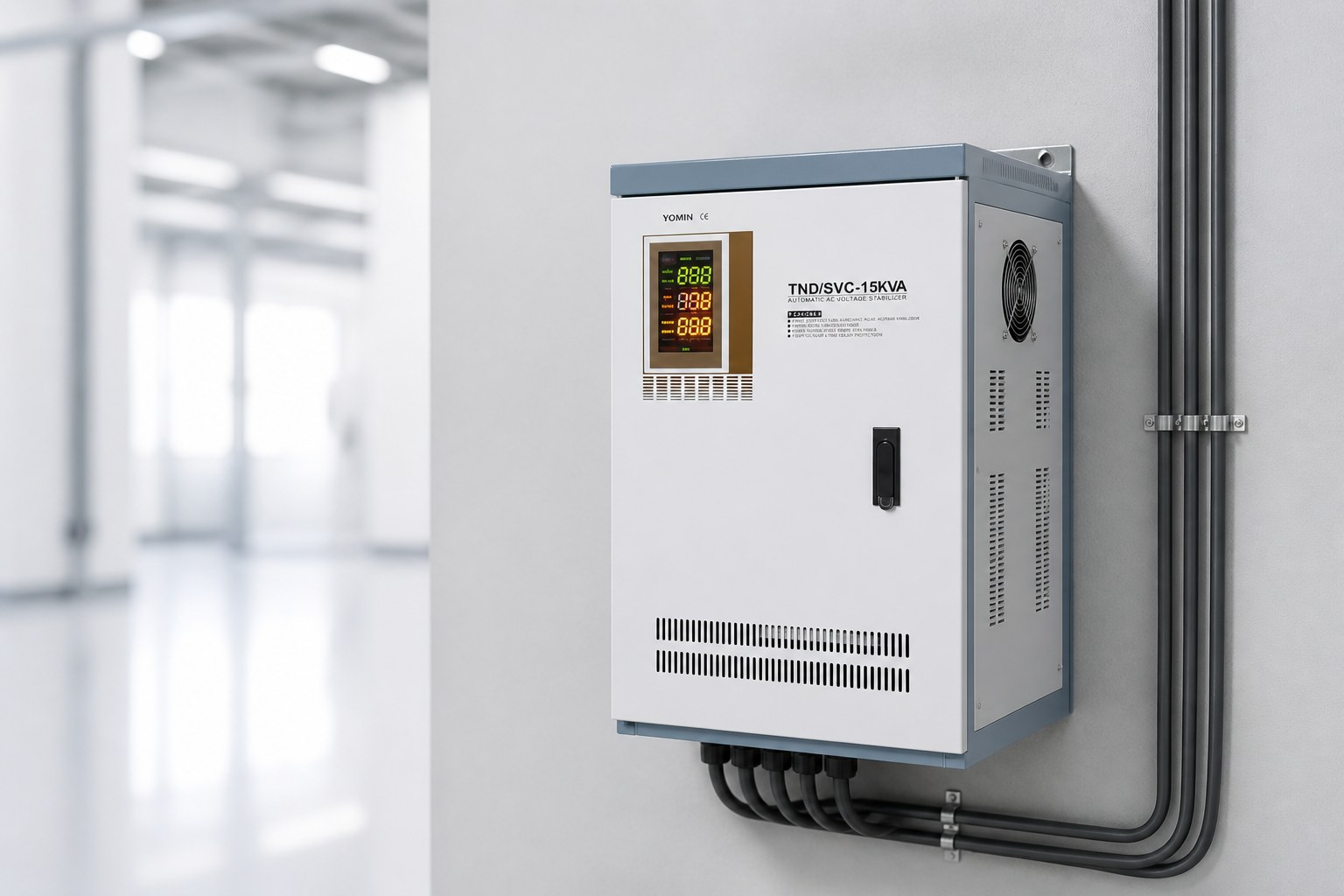
Selecting a voltage regulator (also called a voltage stabilizer or AVR) is mainly a sizing exercise: you must know the input voltage range, the total load in kVA, the number of phases, and the speed and accuracy the equipment needs. Miss any one of these and the unit will either be undersized and trip, oversized and waste money, or too slow to protect sensitive electronics. This voltage regulator selection guide gives you the steps and the numbers to get it right the first time.
Step 1: Measure the Real Input Voltage Range
The first input to any voltage stabilizer selection is not the load, but the supply. Record the line voltage at the worst moments: at night with light load, during peak daytime load, and during motor starts or welding nearby. Use a logging meter for at least a week if the supply is known to be unstable.
Express the result as a range, for example 160–260 V on a nominal 230 V single-phase supply. The regulator you choose must cover the whole measured band, not just the nominal voltage. Common standard ranges are:
| Input range | Typical for |
|---|---|
| 180–260 V | Stable urban supplies (single phase) |
| 160–260 V or 140–270 V | Rural, industrial areas with brownouts |
| 280–480 V (3-phase) | Industrial three-phase supplies |
| 90–260 V wide range | Very weak grids, generators, solar hybrids |
If the measured low voltage is below the stabilizer’s range, the unit will output undervoltage or switch to bypass. Choose a wider input range than the typical measurement and you keep a safety margin for seasonal and future changes.
Step 2: Size the kVA Correctly
Voltage regulator sizing starts with the load, not the breaker. Add up the running loads you will feed, in kVA (or in kW divided by the power factor). Then apply a margin for inrush and future growth:
- Add the nameplate kVA of all equipment that runs continuously.
- Add the largest single motor or starting load separately (motors can draw 5–7× rated current at start).
- Apply a practical safety factor of 1.2–1.5 for future loads and switching transients.
Example: continuous load of 18 kVA plus one 5 kVA air conditioner gives 23 kVA. With a 1.3 factor, the stabilizer should be at least 30 kVA. Running a stabilizer at or above its rated limit reduces its life and output accuracy.
Step 3: Single Phase or Three Phase
Match the stabilizer to the supply:
- Single-phase regulators protect 230 V circuits: homes, small shops, medical rooms, servers, and single machines.
- Three-phase regulators protect 380–480 V industrial supplies. Within three-phase units, choose between three-phase balancing (one common correction for all phases) and phase-by-phase correction where each phase is regulated independently. Unbalanced loads need per-phase correction.
For a factory with mixed loads, three-phase with per-phase regulation is usually the right voltage regulator selection, especially where single-phase loads are spread unevenly across phases.
Step 4: Choose the Stabilizer Technology
How to choose a voltage stabilizer also means choosing how it corrects voltage. The three mainstream technologies are:
| Technology | Speed | Accuracy | Best for |
|---|---|---|---|
| Relay (tap-change) | Slow (stepped) | ±5–10% | Low-cost home and small loads |
| Servo motor | Medium (10–30 ms per step) | ±1–2% | Industrial machines, AC, pumps, whole buildings |
| Static / solid-state | Very fast (<1 ms to 1 cycle) | ±0.5–1% | Medical, lab, CNC, sensitive electronics |
A servo voltage stabilizer is the workhorse for most industrial and commercial installations: smooth correction, good accuracy, and reasonable cost. Choose static (solid-state) regulation when the protected equipment cannot tolerate even a brief dip or transient, and choose relay type only for simple, low-cost domestic loads.
Step 5: Check Regulation Speed and Output Accuracy
Response time matters more when the load is sensitive. CNC machines, imaging systems, laboratory instruments, and data equipment need fast correction with tight output tolerance. For these, specify output accuracy of ±1% and a correction time measured in milliseconds to a few cycles. For pumps, compressors, and general workshop loads, ±1–2% with a servo drive is normally sufficient.
Step 6: Verify Protection and Operating Features
A good stabilizer is also a protector. Confirm the unit includes:
- Over-voltage and under-voltage cut-off with auto-restart.
- Overload and short-circuit protection.
- Phase loss, phase sequence, and neutral loss detection (three-phase units).
- Bypass mode so power continues if the unit needs service.
- High/low temperature cut-off and cooling fans for continuous duty.
- Digital display of input/output voltage, current, and status.
These features are what separate an appliance from an industrial-grade unit, and they are the ones you should compare directly between offers.
Step 7: Plan Installation and Environment
Place the stabilizer indoors, away from dust, moisture, and direct sun, with clearance for airflow. Allow spare capacity for ambient temperatures above 40 °C and for derating at altitude. Confirm the enclosure rating (IP20/IP43) and whether the unit is wall-mount or floor-standing for the kVA you need.
For a complete solution, pair the stabilizer with a Yomin voltage stabilizer regulator sized from the checklist above and, where monitoring matters, add an energy meter downstream to verify the delivered voltage and load in real time.
Voltage Regulator Selection Checklist
| Parameter | How to determine it | Example result |
|---|---|---|
| Input range | 1-week voltage logging | 160–260 V |
| Capacity | Sum of loads × 1.2–1.5 | 30 kVA |
| Phases | Supply type + balance | 3-phase, per-phase correction |
| Technology | Load sensitivity | Servo, ±1% |
| Speed | Equipment tolerance | <1 cycle for CNC/medical |
| Protection | Required cut-offs | UV/OV + phase loss + bypass |
| Environment | Site conditions | Indoor, IP43, wall mount |
Work through the list in order and the model chooses itself. If your site has an unusual supply, unbalanced phases, or a mix of sensitive and motor loads, send us the load list and the measured voltage range and our engineers will propose the right unit from the voltage stabilizer range.
Q&A
How do I calculate the kVA rating I need for a voltage stabilizer?
Short answer: Add the running kVA of all protected loads, add the largest motor start separately, then multiply the total by 1.2–1.5 for margin. Round up to the nearest standard rating. For example, 23 kVA of connected load with a 1.3 margin becomes a 30 kVA stabilizer.
What is the difference between a servo and a static voltage stabilizer?
Short answer: A servo stabilizer uses a motor-driven variable transformer and corrects voltage in about 10–30 ms per step with roughly ±1–2% accuracy. A static (solid-state) stabilizer corrects in under one cycle with tighter accuracy, but costs more. Use servo for general industrial loads and static for sensitive electronics, medical, and lab equipment.
Can a three-phase stabilizer protect unbalanced loads?
Short answer: Only if it regulates each phase independently. A common three-phase unit corrects all phases together, which does not fix phase imbalance. For factories with single-phase loads spread unevenly across phases, choose a three-phase stabilizer with per-phase correction.
What input voltage range should I choose?
Short answer: Measure the actual line voltage over a full week and select a stabilizer whose input range covers the worst measured low and high values with margin. Standard industrial ranges are 160–260 V single phase and 280–480 V three phase; choose a wider range if the grid is weak.
Does the stabilizer protect against overvoltage too?
Short answer: Yes, if the unit includes over-voltage cut-off. Confirm the unit trips at the configured high threshold and restarts automatically when the supply returns to normal. This protects connected equipment during neutral failures, transformer faults, and utility switching events.
Need Help Choosing the Right Product?
Our engineers can recommend the exact model, rating and configuration for your project. Tell us your requirements and get a factory-direct quote within 24 hours.