Voltage Stabilizers Explained: How to Protect Your Appliances
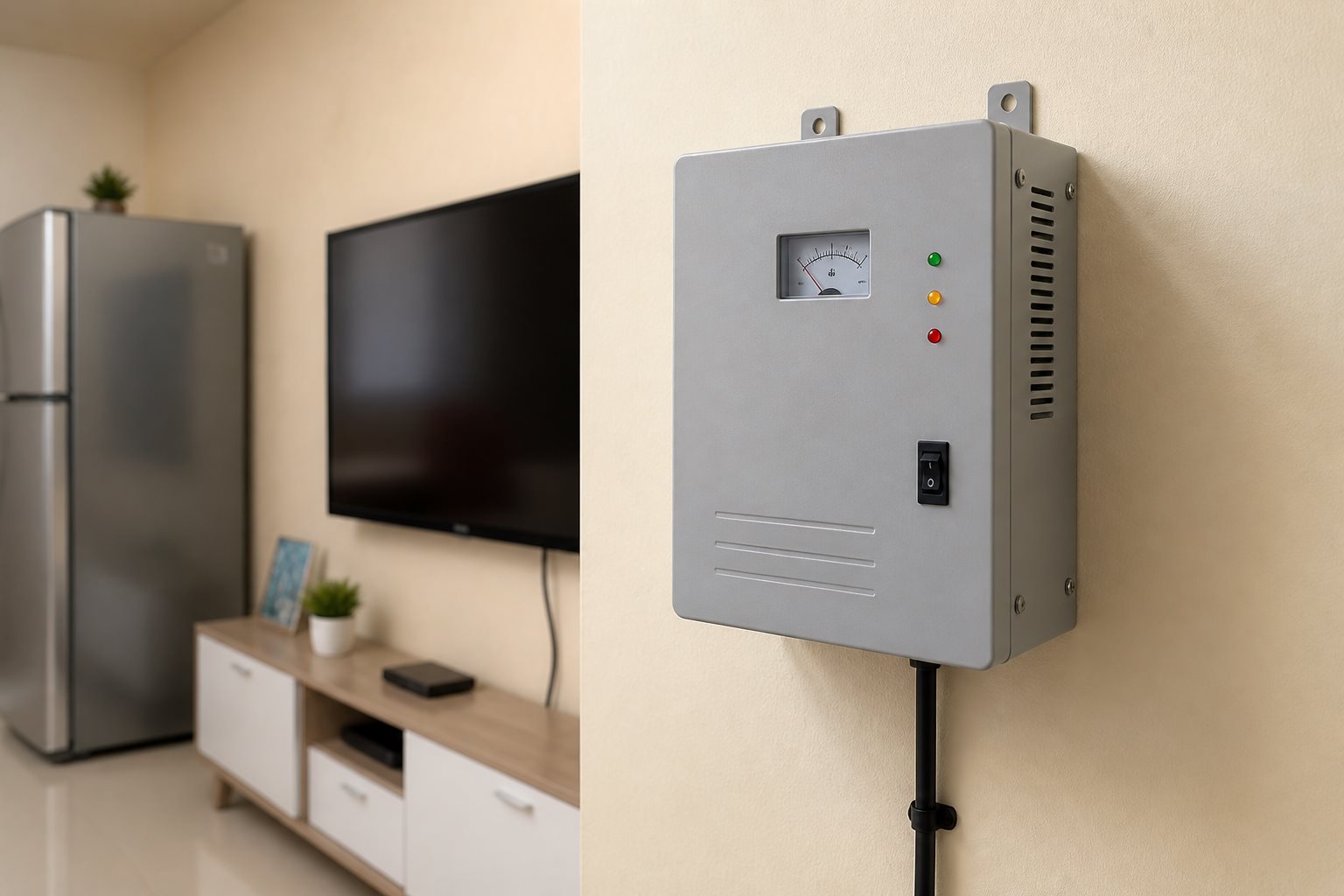
If the lights in your home sometimes dim when the air conditioner switches on — or flicker when the neighbor starts a machine — your electricity supply has voltage fluctuations. In many countries this is a daily reality, and it slowly damages the appliances you paid good money for. A voltage stabilizer is the low-cost device that stops that damage.
This guide explains why voltage fluctuates, how stabilizers fix it, and how to choose the right one — in simple terms anyone can follow.
Why Does Voltage Fluctuate?
Voltage is like water pressure in a pipe: it should stay steady, but real conditions change it. Voltage fluctuates when the grid is overloaded, when power lines are long and thin, when large motors start up nearby, or when backup generators run unevenly. The result is that your wall socket may deliver far less — or sometimes more — than the 220V or 110V your appliances expect.
How Voltage Problems Damage Appliances
- Under-voltage (brownout): motors run slower and hotter, compressors strain, and electronic circuits behave unpredictably. Repeated brownouts shorten the life of refrigerators, air conditioners, and pumps.
- Over-voltage: too much voltage pushes excess current through circuits, overheating power supplies and burning out electronics — often instantly.
- Fluctuation stress: the constant jumping between high and low is what wears components out fastest, even when no single event is fatal.
Modern appliances are full of sensitive electronics — inverter compressors, digital control boards, touch displays. They tolerate clean, steady power and suffer quietly under unstable power. That quiet suffering shows up as repairs, shorter lifespans, and premature replacement.
What Does a Voltage Stabilizer Do?
A voltage stabilizer — also called a voltage regulator or AVR (automatic voltage regulator) — sits between your mains supply and your appliances. It constantly watches the incoming voltage and corrects it to the right level before the electricity reaches your devices. If the supply drops to 180V, the stabilizer lifts it back to 220V. If it rises to 250V, the stabilizer brings it down.
Two main technologies are used:
- Relay-type stabilizers: affordable, switch correction steps automatically, ideal for household appliances.
- Servo-motor stabilizers: smoother and more precise, recommended for industrial equipment, medical devices, and installations with wide voltage swings.
Stabilizer, Surge Protector, or UPS?
- Surge protector: only blocks sudden spikes (like lightning or switching surges). It does nothing about slow, continuous fluctuation.
- Voltage stabilizer: continuously corrects voltage. It is the right tool for regions with chronic fluctuation.
- UPS: provides battery backup during power cuts, and usually includes some voltage correction. Use it for computers and equipment that cannot tolerate even a second of downtime.
Many families use all three: a surge protector for TVs, a stabilizer for refrigerators and air conditioners, and a UPS for the computer.
How to Choose the Right Voltage Stabilizer
Choosing is easier than it looks. Follow these four steps:
- Add up the wattage of everything the stabilizer will protect (check the label on each appliance).
- Add a safety margin of at least 25–30% — motors draw up to three times their running power when starting.
- Match the phase: single-phase for homes and small shops; three-phase for factories and large equipment.
- Check the input range: the wider the range the stabilizer accepts (for example 140V–260V), the more protection you get in regions with severe fluctuation.
For example, a refrigerator drawing 200 W plus a TV drawing 150 W totals 350 W. Add the 30% margin and you land at about 455 W — so a 500 VA stabilizer is the sensible minimum. For a detailed selection method, see our voltage stabilizer buying guide, or browse our range of voltage stabilizers and regulators.
Do You Really Need One?
If your electricity is generally stable, a stabilizer is optional. If any of these sound familiar, it is a wise investment:
- Lights dim or flicker when big appliances start.
- Your area has frequent outages, generator power, or rural supply lines.
- You have replaced appliances twice in a few years for "no reason."
- You rely on sensitive equipment — medical devices, servers, printing presses, or laboratory instruments.
A good stabilizer costs a fraction of one refrigerator or television. Protecting your appliances also protects your budget — which is exactly why stabilizers are standard equipment in millions of homes worldwide.
Frequently Asked Questions
What size voltage stabilizer do I need?
Add up the wattage of the appliances you want to protect and add a safety margin of 25 to 30 percent. For example, a refrigerator and TV drawing 400 W together would need at least a 500 VA stabilizer — bigger is always safer.
Can a voltage stabilizer reduce my electricity bill?
A stabilizer improves power quality but does not significantly reduce your bill. Its real value is protecting appliances, which prevents expensive repairs and early replacement.
Do I need a stabilizer for my refrigerator?
In areas with frequent voltage fluctuations, yes. Refrigerators contain compressors and electronic controls that are among the most damage-prone appliances. A stabilizer sized for the compressor's starting surge is recommended.
What is the difference between a stabilizer and a UPS?
A stabilizer corrects voltage but cannot supply power during an outage. A UPS (uninterruptible power supply) provides battery backup during blackouts and usually includes voltage protection too. For protecting computers, a UPS is the better choice.
Protect Your Equipment with Reliable Stabilizers
We manufacture single-phase and three-phase voltage stabilizers and regulators — from 500 VA to industrial sizes, with CE certification.
Request a Quote →