What Is a Bidirectional Meter? How It Enables Solar Net Metering
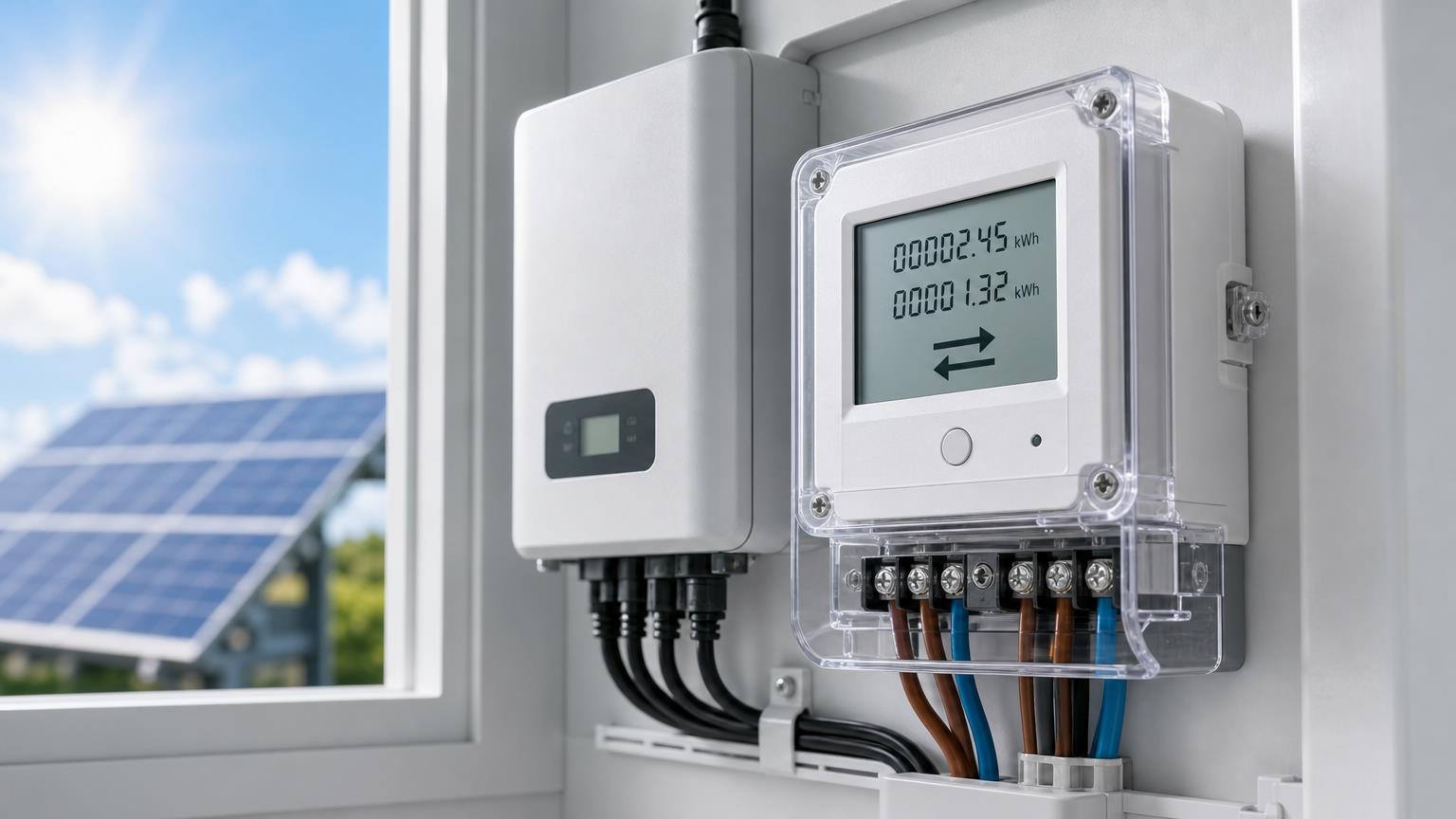
A bidirectional (two-way) meter measures electricity flowing in both directions — what you import from the grid and what you export to it. For any home or business with solar panels, this meter is the hardware that makes net metering work: it keeps separate import and export registers so your utility can credit you for surplus generation.
Why a normal meter isn't enough
A standard kWh meter counts energy in one direction only. When your solar array produces more than the building consumes, power flows backwards through the meter into the grid — and a standard meter either ignores it or (in older designs) can even mis-register it. A bidirectional meter senses the direction of current flow in real time and records:
- Import register: energy drawn from the grid.
- Export register: surplus energy sent to the grid.
How it works
- Current transformers (or direct sensing) feed instantaneous current and direction data to the metering electronics.
- Phase-angle measurement determines whether power flows into or out of the premises.
- Each direction accumulates into its own register (and many meters also store time-of-use data per direction).
- At billing time the utility reads both registers — net metering subtracts export from import.
Modern bidirectional smart meters go further: they log interval data for both directions, support TOU tariffs per direction, and can be read remotely over RS485, PLC or RF.
Net metering vs gross metering
| Scheme | Metering | Billing |
|---|---|---|
| Net metering | One bidirectional meter | Bill = (import − export) × rate |
| Gross / feed-in | Two meters (or dual registers) | Pay for all consumption, get paid for all generation separately |
Net metering is common for residential solar; gross/feed-in tariffs are common where regulators want to reward all solar output. Your utility's policy decides which scheme (and which meter) applies.
Bidirectional meters and battery storage
Add a battery and the bidirectional meter becomes the control point for the whole energy flow:
- Charge the battery from solar surplus instead of exporting at low rates.
- Discharge in the peak window to avoid expensive import.
- The meter still tracks true grid import/export, which is what billing and net metering are based on.
If you're building the metering system yourself (off-grid, islanding, or private microgrids), choose a bidirectional-capable energy meter with import/export registers — and pair it with the right CTs for your feeder size.
Choosing a bidirectional meter
- Import/export registers: confirm both directions are recorded (some meters show a single net value only).
- TOU support per direction: needed if your tariff prices import and export differently by time of day.
- Communication: RS485/Modbus for remote reading and data logging.
- Accuracy and certification: IEC 62053 (and MID where applicable) for billing-grade use.
- Solar-rated options: for DC circuits (battery, PV string monitoring), dedicated DC energy meters measure the DC side directly.
FAQ
What is a bidirectional meter?
A bidirectional (two-way) meter measures electricity flowing in both directions: energy imported from the grid and energy exported to the grid (for example surplus solar). It keeps separate registers for import and export so the utility can apply net metering.
Do I need a new meter for solar net metering?
Usually yes. Standard meters only measure one direction. Net metering requires a bidirectional meter (or a smart meter with bidirectional capability) that records export separately. Your utility will typically install or authorize one.
How does a bidirectional meter work?
It senses the direction of current flow in real time. When you consume from the grid, the import register advances; when your solar exports surplus, the export register advances. The difference is your net usage or net credit.
What is the difference between net metering and gross metering?
Net metering offsets your import against your export and bills the difference (one bidirectional meter). Gross metering pays you for all solar generation and charges you for all consumption separately (two meters).
Final Thoughts
If you have solar, a bidirectional meter is the meter that pays you back. It records both directions accurately, supports net metering, and pairs naturally with batteries and TOU tariffs. Yomin Electric supplies bidirectional energy meters with import/export registers and RS485 readout, plus DC meters for the solar side — everything needed for a complete solar metering package.
Related reading: Solar PV Meters and What Is a DC Energy Meter.
Need Help Choosing the Right Product?
Our engineers can recommend the exact model, rating and configuration for your project. Tell us your requirements and get a factory-direct quote within 24 hours.