CT Ratio Explained: How to Choose the Right Current Transformer Ratio
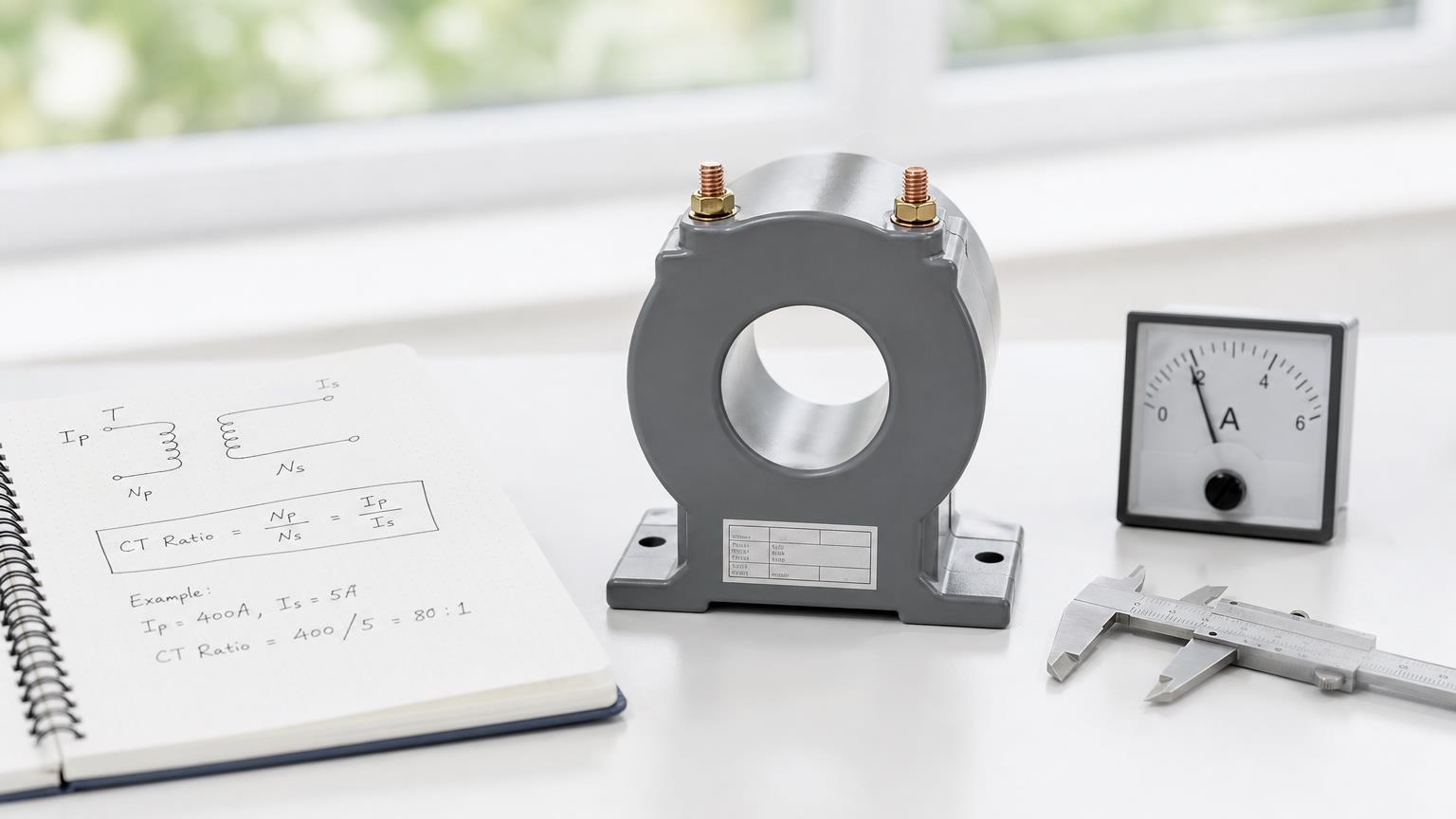
CT ratio is the ratio between the current flowing in the primary conductor and the reduced current delivered to the meter or relay, written like 100:5 or 200:5. Choosing the wrong ratio is the most common CT mistake in the field: too low and the CT saturates and reads wrong; too high and the meter runs at the bottom of its accuracy band. Here's how to get it right the first time.
What the numbers mean
A 100:5 CT means: when 100 A flows through the primary conductor, exactly 5 A appears at the secondary terminals. The meter reads 5 A and you multiply by the ratio (100 ÷ 5 = 20) to recover the real current. Common secondary ratings are 5 A and 1 A; common primary ratings follow standard series: 50, 100, 150, 200, 250, 300, 400, 500, 600, 800, 1000 A and beyond.
How to choose the ratio
- Estimate maximum load current: sum the full-load amps of everything on the circuit (or derive from the breaker rating).
- Add margin: pick a primary rating at or above 1.25× your expected maximum — this keeps normal operation in the CT's most accurate range (roughly 20–100% of rated current).
- Round up to a standard rating.
Example: a 60 A maximum load → 60 × 1.25 = 75 A → choose a standard 100:5 CT. A 400 A feeder → 500:5 or 600:5 depending on expected growth.
Quick reference table
| Max load current | Recommended CT ratio | Meter multiplier |
|---|---|---|
| Up to 40 A | 50:5 | 10 |
| 40–80 A | 100:5 | 20 |
| 80–120 A | 150:5 | 30 |
| 120–160 A | 200:5 | 40 |
| 160–240 A | 300:5 | 60 |
| 240–320 A | 400:5 | 80 |
| 320–480 A | 600:5 | 120 |
| 480–800 A | 1000:5 | 200 |
Metering vs protection CTs
Don't use one where the other belongs:
- Metering CTs (class 0.2s, 0.5s, 1.0) are accurate across the normal load range but saturate under faults to protect connected instruments.
- Protection CTs (5P10, 10P20, etc.) stay accurate up to many times rated current so relays see true fault levels.
For metering installations, always use metering-class CTs matched to your energy meter's burden specification.
Common mistakes
- Oversizing: a 600:5 CT on a 50 A load reads at the very bottom of its range where accuracy degrades.
- Undersizing: a 50:5 CT on a 90 A load saturates and under-reports exactly when load is highest.
- Mixing secondaries: wiring a 5 A meter to a 1 A secondary CT (or vice versa) reads 5× wrong.
- Leaving the secondary open: never energize a CT with an open secondary — dangerous high voltage can develop.
FAQ
What does CT ratio mean?
CT ratio is the ratio of primary current to secondary current, written like 100:5 or 200:5. A 100:5 CT steps 100 A on the primary down to 5 A on the secondary, so the meter safely reads 1/20th of the actual current.
How do I choose the right CT ratio?
Estimate your maximum expected load current, then pick the next standard CT primary rating at or above about 1.25× that load, so the meter operates in the accurate 20–100% range. For a 60 A max load, a 100:5 CT is a typical choice.
What is the difference between metering and protection CTs?
Metering CTs (class 0.2s–1.0) prioritize accuracy in the normal operating range. Protection CTs (5P10, 10P20) must stay accurate under fault currents to drive relays, and use a different class notation. Don't swap one for the other.
How do I calculate kW from a CT reading?
Multiply the secondary reading by the CT ratio: actual current = secondary amps × ratio. Then kW = volts × amps × power factor ÷ 1000 (single phase), or × √3 for three phase.
Final Thoughts
CT ratio is simple once you work from load current upward: estimate, add 25% margin, round to standard, and keep metering CTs on meters. Yomin Electric supplies CTs from 50:5 to 1000:5+ in metering and protection classes, matched to our energy meters — tell us your load and we'll confirm the ratio before you order.
Related reading: How to Choose a Current Transformer and What Is a Current Transformer Meter.
Need Help Choosing the Right Product?
Our engineers can recommend the exact model, rating and configuration for your project. Tell us your requirements and get a factory-direct quote within 24 hours.