How Much Does a Current Transformer Cost? A Pricing Guide for Buyers
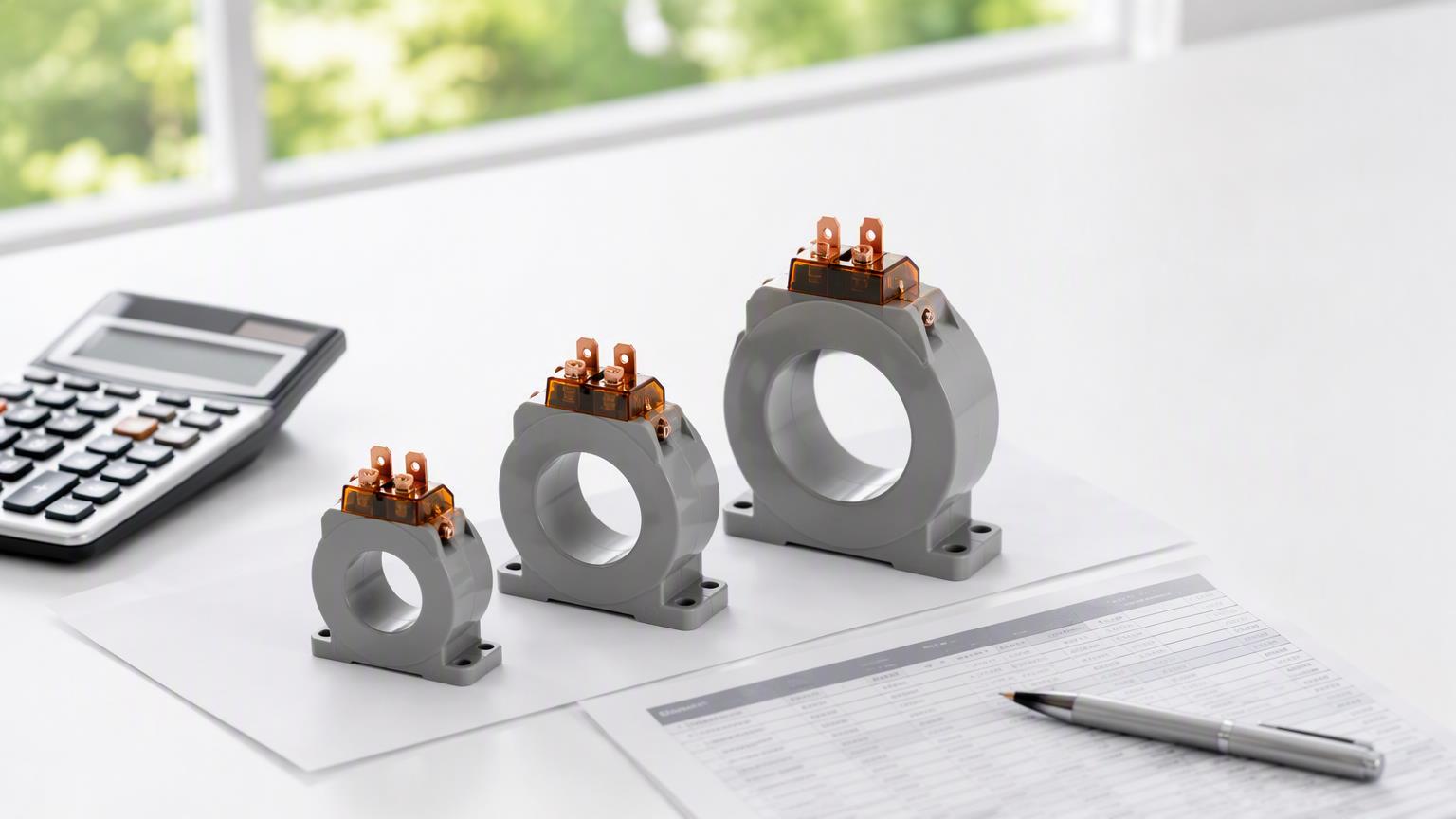
A current transformer (CT) typically costs between $3 and $150+ per unit, depending on type, accuracy class, ratio, and order volume. Small solid-core ring CTs for meter mounting are at the low end; high-accuracy instrument CTs for billing or MV installations sit at the top. This guide breaks down what drives the price so you can budget accurately — and avoid overpaying or buying the wrong class.
Typical price ranges by type
The figures below are typical FOB ranges for order volumes of 100–1,000 pieces (prices vary by market and specifications):
| CT type | Typical unit price | Typical use |
|---|---|---|
| Solid-core ring CT (class 1.0) | $3–$10 | DIN-rail meter mounting, monitoring |
| Solid-core ring CT (class 0.5s) | $8–$20 | Submetering, billing-grade metering |
| Split-core CT | $10–$40 | Retrofit monitoring without disconnecting cables |
| Bar-type / busbar CT | $15–$60 | High-current feeders, switchgear |
| High-accuracy instrument CT (0.2s) | $40–$150+ | Revenue metering, utility billing |
| MV / protection CTs (11–33 kV class) | $100–$500+ | Substation protection and metering |
What drives the price
- Accuracy class: 0.2s and 0.5s CTs use better core materials and tighter winding control than class 1.0 — the biggest single cost factor.
- Core material: silicon steel is standard; nanocrystalline cores cost more but reduce size and improve accuracy at low current.
- Primary rating and window size: bigger windows (to fit large busbars) mean more core material and higher price.
- Secondary rating: 5 A secondaries are common and cheaper; 1 A secondaries for long cable runs cost more.
- Burden (VA): higher burden ratings require a larger core.
- Insulation and certification: MID/IEC 61869 certified units with full test certificates cost more than uncertified equivalents.
- Quantity: MOQ and volume discounts are significant — 1,000 pieces can cost 30–50% less per unit than 100.
Don't buy on price alone
Cheap CTs from unknown suppliers are the #1 source of metering accuracy problems. Three checks prevent bad buys:
- Verify the ratio and class on the nameplate — and ask for the test report, not just the datasheet.
- Confirm saturation behaviour: a CT that saturates below your fault or overload current will read wrong exactly when it matters.
- Check certification: for billing use, require IEC 61869-2 / IEC 62053 compliance and factory test certificates.
Yomin Electric’s current transformer range covers ring, split-core and bar types from class 1.0 to 0.2s, with individual test reports on request — factory-direct pricing that typically beats trading-company quotes by 20–40%.
Budgeting tips
- For a submetering project, budget class 0.5s CTs — the accuracy pays for itself through fair billing.
- For simple monitoring, class 1.0 is enough; don't pay for 0.5s you don't need.
- Order spares (5–10%) — CT failures are rare but replacement lead times are long.
- Buy CTs and meters from one supplier to guarantee matched ratios and burden ratings.
FAQ
How much does a current transformer cost?
Typical unit prices range from about $3–$15 for small solid-core ring CTs at volume, $10–$40 for split-core CTs, and $30–$150+ for high-accuracy (0.2s/0.5s) or high-voltage instrument CTs. Final price depends on ratio, accuracy class, window size, burden, and order volume.
Why do current transformer prices vary so much?
Cost drivers are accuracy class (0.2s costs more than 1.0), core material (silicon steel vs nanocrystalline), window/primary rating, insulation level (up to 0.66 kV typical vs MV), certification (MID, IEC), and quantity. A 5 A secondary CT also differs from a 1 A secondary.
What is the cheapest current transformer type?
Solid-core (ring-type) CTs for meter mounting are generally the lowest cost. Split-core CTs cost a bit more because of the hinged core and machining, but save installation labour because the conductor does not need to be disconnected.
Is it worth paying more for a higher accuracy class CT?
For revenue billing, yes — accuracy class 0.5 or better per IEC 62053/61869 is required and small errors compound over thousands of kWh. For basic monitoring, class 1.0 is usually sufficient and much cheaper.
Final Thoughts
CT pricing is transparent once you know the levers: type, class, ratio, volume. Budget from the table above, verify test reports, and buy matched CT+meter packages. Get a factory-direct current transformer quote from Yomin Electric and we’ll confirm class, burden and ratio against your meter before you commit.
Related reading: How to Choose a Current Transformer and What Is a Current Transformer.
Need Help Choosing the Right Product?
Our engineers can recommend the exact model, rating and configuration for your project. Tell us your requirements and get a factory-direct quote within 24 hours.