What Is a Current Transformer? Explained in Plain Language
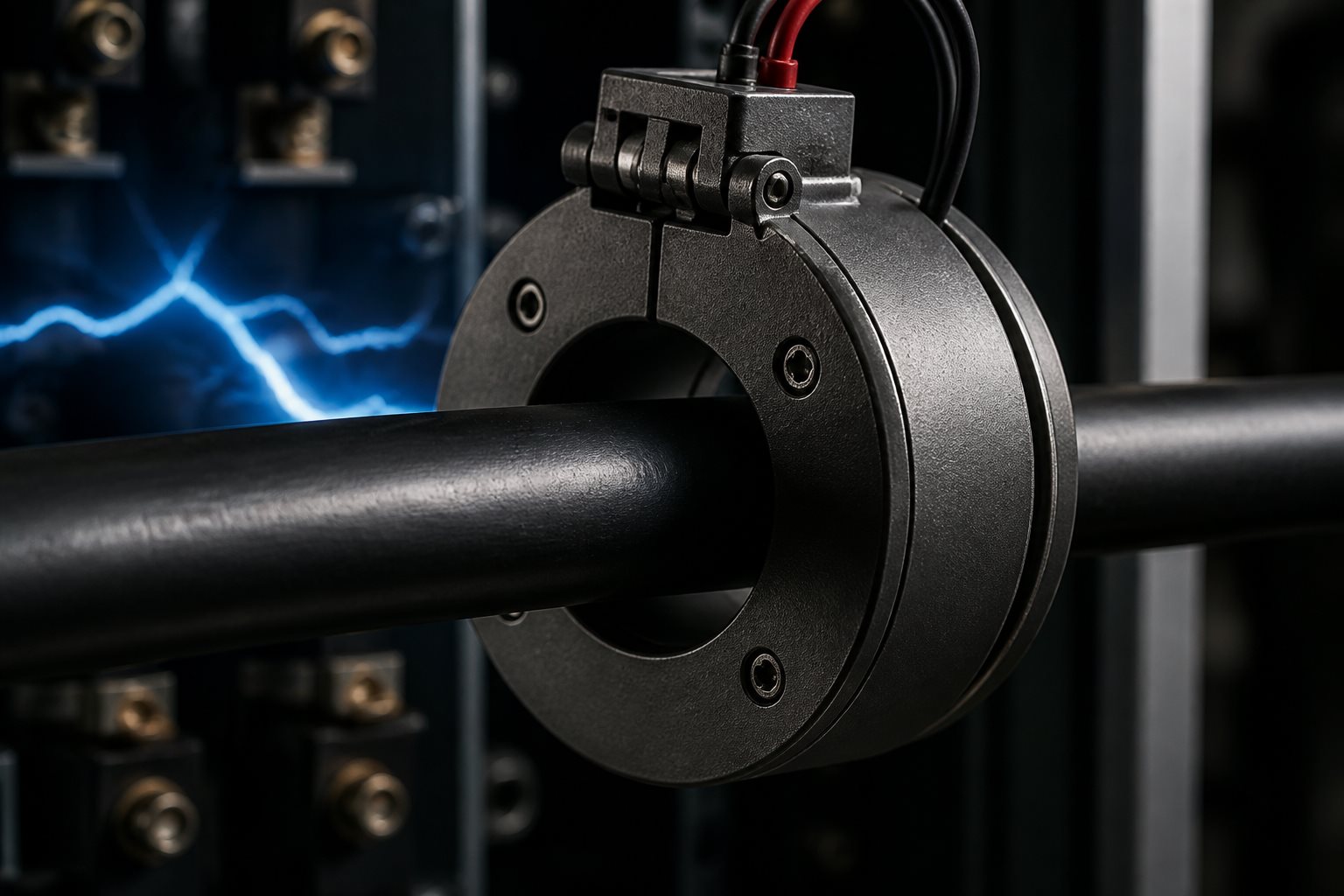
Have you ever noticed a donut-shaped device clamped around a thick electric cable? That is a current transformer (CT) — one of the most important, yet least understood, pieces of equipment in the electrical world. It makes huge currents measurable, keeps meters and relays safe, and helps bill billions of kilowatt-hours correctly every single day.
In this guide, we explain what a current transformer is, how it works, and why it matters for your home, your factory, or your utility — in words everyone can understand.
The Problem: Measuring Huge Currents Is Hard
Imagine you need to weigh a truck, but your scale can only handle 50 kilograms. You would not build a bigger scale — you would weigh one wheel, then multiply. A current transformer works on exactly this idea.
A factory line might draw 1,000 amperes of current. You cannot connect an energy meter directly to a cable carrying that much power — it would be dangerous, expensive, and the meter would have to be enormous. Instead, a current transformer takes a tiny, safe "sample" of that current and sends it to the meter.
What Is a Current Transformer?
A current transformer is a simple device with one cable passing through a ring of magnetic material, surrounded by a coil of thin wire. It steps large currents down to a small, standard level — usually 5 amperes or 1 ampere — that instruments can safely handle.
Every CT has a ratio written on it, like 100/5 or 500/5. When 500 amperes flow through the main cable, the CT produces exactly 5 amperes in its secondary wires. Multiply the meter reading by the ratio, and you know the true current. This is why CTs are the standard partner of electricity meters in commercial and industrial installations.
How Does a Current Transformer Work?
Current creates a magnetic field around a wire — the stronger the current, the stronger the field. A current transformer wraps a coil around that magnetic field. The field "pushes" electricity through the coil, creating a small current that is always proportional to the big current in the cable.
In other words, the CT does the heavy lifting so the meter only sees a small, safe copy of the real current. And because the CT is a passive device, it needs no power supply of its own — it works using the energy of the current it measures.
Where Are Current Transformers Used?
- Energy metering: every three-phase commercial meter and many smart meters rely on CTs to measure large loads accurately for billing.
- Protection: protective relays use CTs to detect dangerously high currents and trip circuit breakers in milliseconds, preventing fires and equipment damage.
- Monitoring: factories and data centers use CTs to track power use per machine, machine line, or building floor.
- Solar and storage: CTs measure the flow between solar inverters, batteries, and the grid for net metering.
Accuracy Classes and Ratios
Not all CTs are created equal. The accuracy class tells you how truthful the CT is:
- Class 0.5 and 0.5S: maximum error of 0.5 percent — recommended for revenue billing.
- Class 1.0: maximum error of 1 percent — fine for monitoring and general use.
Choosing the right ratio is also important: the CT should be sized so your normal load sits between about 20% and 100% of its rating. A 500/5 CT on a line that only draws 50 amperes will measure poorly, because the transformer works best in its designed range. For a practical step-by-step process, see our current transformer selection guide.
Solid-Core or Split-Core: Which One Do You Need?
Solid-core CTs are the classic ring — the cable must be threaded through them, which usually means disconnecting the power to install. Split-core CTs open like a clamshell and clip around an existing cable without cutting the power. That makes them the first choice for retrofits and live installations, while solid-core models remain the most accurate and economical choice for new projects.
Both types are available in Class 0.5 and Class 1, with ratios from 5A to 5000A, and both are certified to international standards such as IEC 61869.
Frequently Asked Questions
Why do current transformers have a ratio like 500/5?
The ratio describes how much the transformer scales the current down. A 500/5 CT means that when 500 amperes flow in the main cable, exactly 5 amperes flow in the secondary circuit — a safe, measurable level for meters and relays.
Do current transformers need their own power supply?
No. Measuring CTs are passive devices — the current flowing in the cable creates the signal by itself. This is why they work even in old installations with no auxiliary power.
What is the difference between measuring and protection CTs?
Measuring CTs are optimized for accuracy at normal loads (for billing and monitoring). Protection CTs are designed to stay accurate even at very high fault currents, so protective relays can detect problems quickly.
What does accuracy class 0.5 mean on a current transformer?
It means the CT reproduces the primary current with a maximum error of 0.5 percent at rated conditions. Class 0.5 and better are recommended for revenue metering, while Class 1 is acceptable for general monitoring.
Need Current Transformers for Your Project?
We manufacture solid-core and split-core CTs from 5A to 5000A, in Class 0.5 and Class 1 — CE certified and export-ready.
Request a Quote →