Modbus and RS485 Energy Meters: A Buyer's Guide for Facility Managers
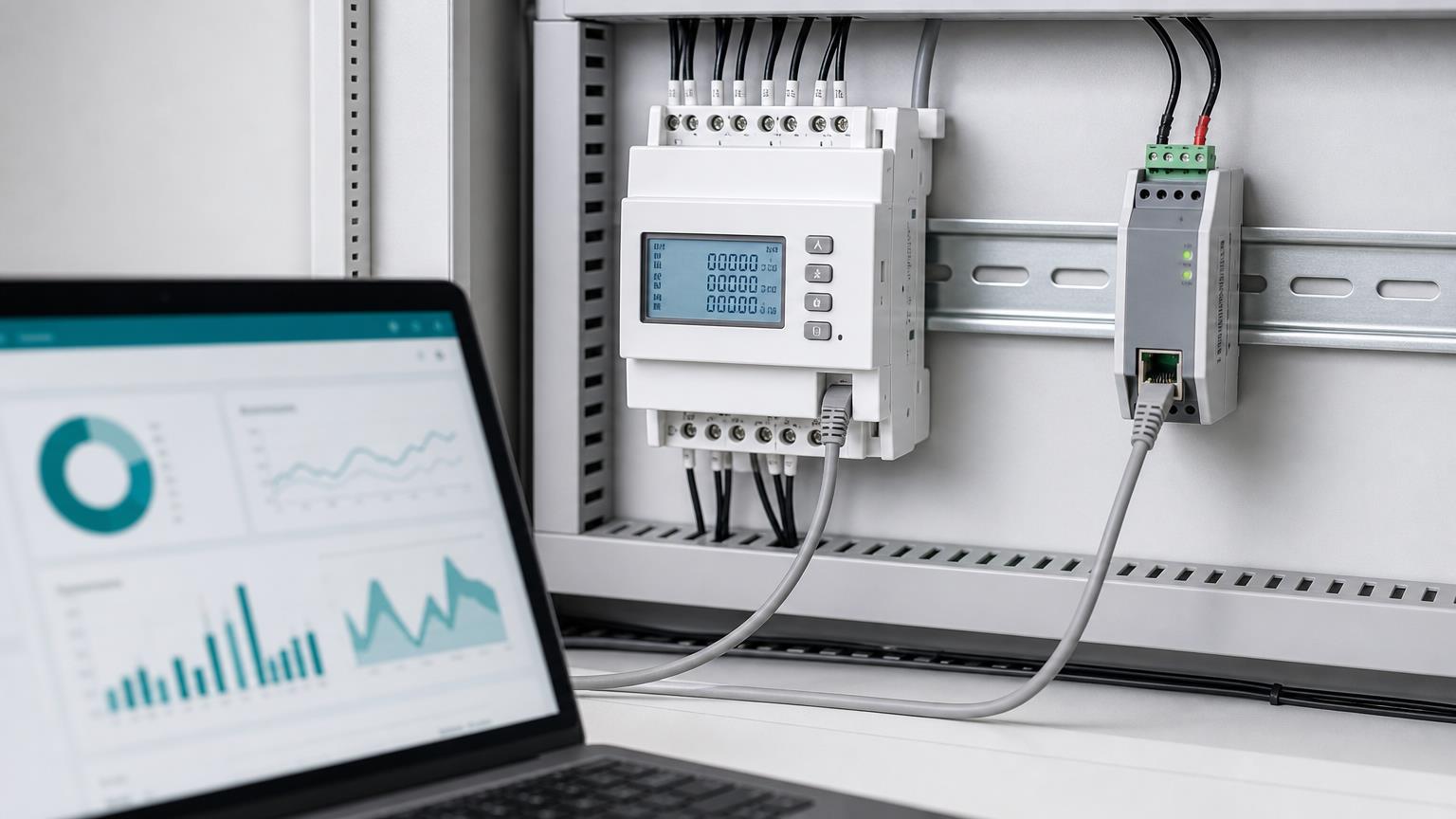
An RS485 Modbus energy meter is an electricity meter that can report voltage, current, power, energy and dozens of other parameters to a controller or monitoring system over a two-wire serial bus. For facility managers, this turns every meter into a data source for energy dashboards, SCADA, and automated billing — without walking around with a clipboard.
What are RS485 and Modbus?
RS485 is a physical wiring standard: a two-wire (A/B) balanced bus that can carry data over hundreds of metres and support many devices on one cable. It is the de-facto serial backbone of industrial and building automation.
Modbus is the protocol that runs on top of it. Modbus RTU (the most common form on meters) sends data in compact binary frames over RS485. Each device has an address, and a master (PLC, gateway, or PC software) polls each address for readings. Modbus TCP is the same protocol over Ethernet, usually via a gateway that converts RS485 to IP.
Why choose a Modbus energy meter?
- Real data, no manual reads: automatically collect kWh, kW, V, A, PF and frequency from every feeder.
- Standard and open: Modbus is public, vendor-neutral, and supported by virtually every SCADA, EMS, BMS, and even Home Assistant.
- Cost-effective: one RS485 bus can carry dozens of meters on a single cable run — ideal for multi-feeder panels and submetering.
- Reliable in industry: RS485 is immune to most electrical noise when wired correctly, which matters inside switchboards.
Wiring basics
- Daisy-chain, don't star: connect meters A-to-A and B-to-B in a single chain from the master.
- Terminate the ends: place a 120 Ω termination resistor at both physical ends of the bus.
- Ground and shield: use shielded twisted pair and ground the shield at one end only.
- Unique addresses: set each meter to a unique Modbus address (1–247).
- Keep runs sensible: up to ~1,200 m total length; reduce baud rate or add repeaters for very long runs.
Typical configuration: 9,600 or 19,200 baud, 8 data bits, even parity, 1 stop bit (8E1) — always check the meter’s datasheet, as defaults vary.
What data can you read?
| Parameter group | Typical registers | Use |
|---|---|---|
| Instantaneous | Voltage, current, active/reactive power, PF, frequency | Live load monitoring |
| Energy | Import/export kWh, kVARh, quadrant registers | Billing and verification |
| Demand | Max demand, timestamped demand windows | Tariff and peak analysis |
| Power quality | THD per phase (on advanced meters) | Troubleshooting and compliance |
Every parameter maps to a specific Modbus register address documented in the meter manual. A gateway or software package (Modbus Poll, Node-RED, Home Assistant, SCADA) reads these registers on a schedule and stores them.
Buyer's checklist
- Accuracy and certification: Class 1 (or 0.5s) per IEC 62053-21; MID certification if billing use is planned.
- Measurement method: direct-connect (up to ~100 A) vs CT-operated meters using current transformers for large feeders.
- Communication options: RS485 Modbus RTU standard; check whether RS485-to-Ethernet (Modbus TCP) or wireless options are available.
- Parameter coverage: confirm the register map includes the parameters you need (especially demand and TOU if relevant).
- Display and local read: a backlit display still helps during commissioning even if everything is remote.
- Form factor: DIN-rail meters install quickly in standard distribution boards.
Integration examples
- Factory energy monitoring: meters on each line feed an EMS dashboard; anomalies trigger alerts.
- Building submetering: per-tenant RS485 meters report to billing software automatically.
- EV charging: a Modbus meter behind the charger measures session energy for cost allocation.
- Home Assistant: hobbyists and prosumers read DIN-rail Modbus meters over a USB-RS485 adapter or TCP gateway to track whole-home and per-circuit use.
FAQ
What is an RS485 Modbus energy meter?
It is an electricity meter with an RS485 serial port that speaks the Modbus RTU protocol, so it can report voltage, current, power, energy and other readings to a controller, gateway, or monitoring system over a two-wire bus.
What is the difference between Modbus RTU and Modbus TCP?
Modbus RTU runs over RS485 serial wiring (two wires, daisy-chained devices) while Modbus TCP runs over Ethernet/IP networks. RTU is common for meters inside panels; TCP is used when meters have Ethernet or when a gateway converts RS485 to IP.
How many devices can be connected on one RS485 bus?
Typically up to 32 devices per bus segment without a repeater, each with a unique address (1–247 in Modbus). Longer runs may need repeaters or lower baud rates.
Can I read a Modbus energy meter with Home Assistant?
Yes. Home Assistant supports Modbus via a serial port or a TCP gateway, and many users integrate DIN-rail Modbus meters to track household or EV-charger consumption.
Final Thoughts
If your facility already has a monitoring system — or you are tired of manual meter rounds — RS485 Modbus meters are the standard, open, cost-effective answer. Buy on accuracy class, register coverage, and certified production, and wire the bus properly once. Yomin Electric’s Modbus RS485 meter range covers Class 1 DIN-rail meters with full register maps for EMS, SCADA, and submetering projects, backed by factory testing on every unit.
Related reading: Factory Energy Monitoring: Cut Costs with Real-Time Data and DIN Rail vs Panel Meters.
Need Help Choosing the Right Product?
Our engineers can recommend the exact model, rating and configuration for your project. Tell us your requirements and get a factory-direct quote within 24 hours.