What Is Power Factor and Why Does It Matter for Your Business?
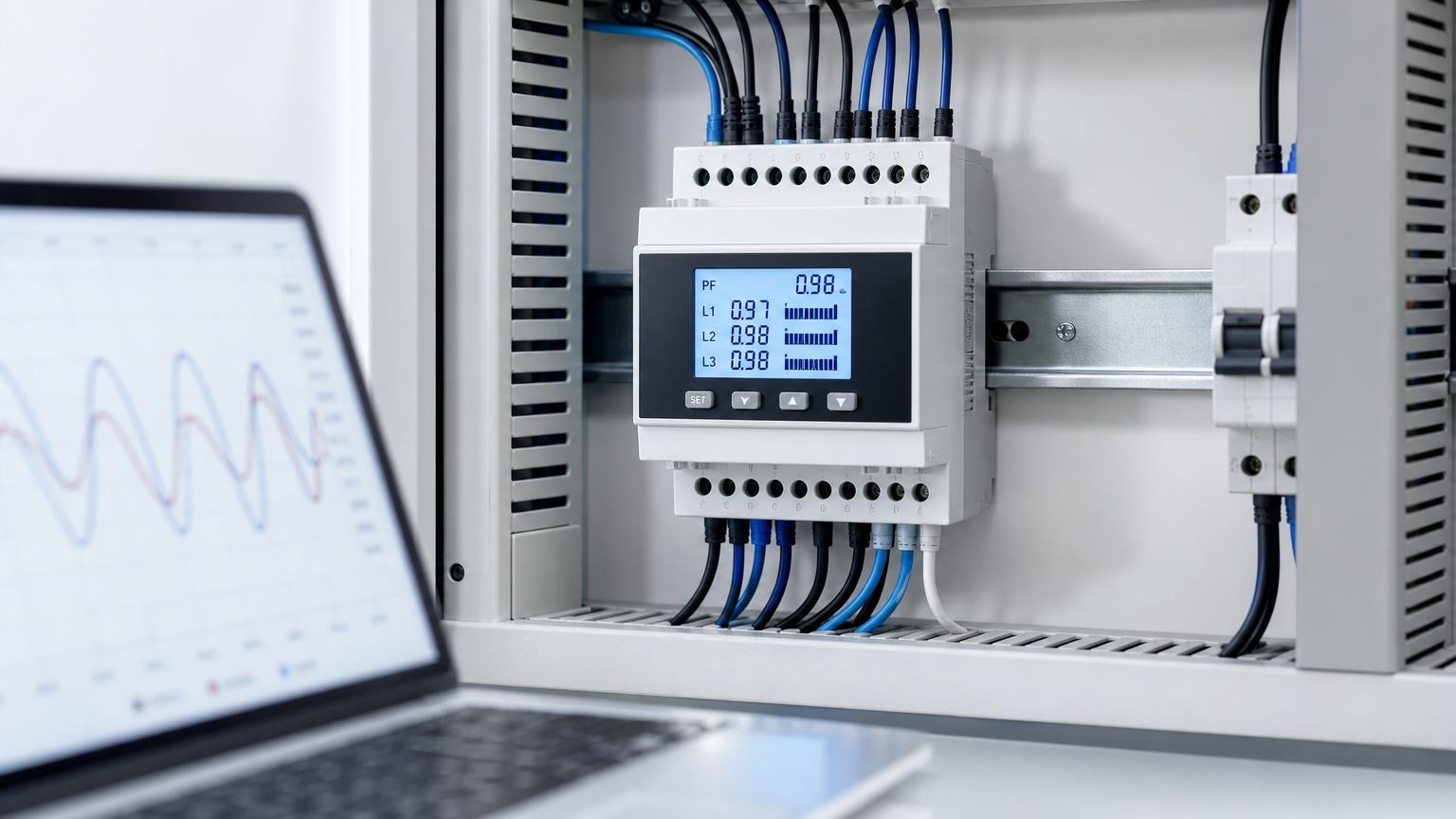
Power factor (PF) is the ratio of real power (kW) to apparent power (kVA) in an AC circuit — in plain terms, how efficiently your facility uses the electricity it draws. A facility with a low power factor pays more for the same useful work: it draws extra current that does no work, and many utilities charge a penalty for it. Measuring and correcting power factor is one of the fastest energy-efficiency wins available to industrial and commercial sites.
The simple definition
In an AC system, two kinds of power exist:
- Real power (kW) — does the useful work: heating, lighting, motor output.
- Reactive power (kVAR) — supports magnetic fields in motors, transformers and coils; it circulates in the system without doing work.
- Apparent power (kVA) — the vector sum of both; what the network must actually deliver.
Power factor = Real power ÷ Apparent power = kW / kVA = cos φ, where φ is the phase angle between voltage and current. A perfect PF is 1.0; most industrial sites run between 0.7 and 0.95.
Why a low power factor costs you money
Three costs hit you when PF drops:
- Utility penalties: many commercial tariffs charge a power factor surcharge below a threshold (commonly 0.85–0.95).
- Higher demand charges: because apparent power (kVA) is what drives transformer and feeder sizing, low PF inflates your billed demand.
- System losses: extra reactive current heats cables, transformers and switchgear — wasted energy that you pay for.
Example: a 500 kW load at PF 0.8 draws 625 kVA. Improve PF to 0.95 and the same load draws only 526 kVA — roughly 16% less current for the same output, which can directly reduce both penalty and demand charges.
What causes low power factor
| Load type | Typical PF | Reason |
|---|---|---|
| Resistive (heaters, incandescent) | ~1.0 | Voltage and current in phase |
| Induction motors (partial load) | 0.6–0.85 | Heavy magnetic field demand |
| Transformers (idle) | 0.1–0.3 | Magnetizing current dominates |
| Welding machines | 0.4–0.7 | Highly inductive, intermittent |
| LED/fluorescent drivers (low quality) | 0.5–0.9 | Non-linear power supplies |
| Modern VFD drives (with PFC) | 0.95–0.99 | Built-in correction |
How to measure it
You cannot see power factor on a standard kWh meter — you need an instrument that measures both kW and kVA, or directly computes cos φ. Options:
- Power analyzer / power quality meter — the definitive tool; measures PF per phase, harmonics, and demand. Yomin’s multifunction energy meters and analyzers display real-time PF alongside kWh.
- DIN-rail multifunction meter with PF display — continuous monitoring at the main panel, ideal for trend analysis.
- Spot measurement with a clamp power meter — quick checks on individual feeders.
For accurate PF readings on large feeders, pair the meter with properly rated current transformers — CT class and burden directly affect measurement accuracy.
How to correct it
- Capacitor banks — the standard solution. Capacitors supply leading reactive power to offset the lagging kVAR of inductive loads. Size them from measured data, not guesswork.
- VFDs with built-in PFC — replace fixed-speed motor starters where possible.
- Load rebalancing — avoid running lightly loaded transformers or motors that draw disproportionate reactive current.
- Verify with monitoring — after correction, keep a multifunction meter in place to confirm PF stays above the utility threshold.
FAQ
What is power factor in simple terms?
Power factor (PF) is the ratio of real power (kW) to apparent power (kVA) in an AC circuit. It shows how efficiently electrical power is being used. A PF of 1.0 means all power is doing useful work; lower values mean more reactive power is circulating in the system.
How is power factor calculated?
PF = Real Power (kW) ÷ Apparent Power (kVA). It equals the cosine of the phase angle between voltage and current (cos φ). It can also be measured directly with a power analyzer.
Why is my power factor low?
Inductive loads such as motors, transformers, compressors, and fluorescent or LED drivers with poor power supplies create lagging reactive power. The more of these loads you run, the lower your facility power factor.
How can I improve power factor?
The standard fix is power factor correction: installing capacitor banks to offset inductive reactive power, plus using modern drives with built-in correction. Measure PF at the main panel first with a power analyzer to size the correction correctly.
Final Thoughts
Low power factor is a silent cost: you pay for current that never does work. The fix starts with measurement — a multifunction meter or power analyzer at the main panel tells you exactly where you stand, and capacitor correction typically pays back quickly through lower penalties and losses. Yomin Electric supplies meters with PF monitoring and the current transformers to measure accurately at any feeder size.
Related reading: Power Meter vs Power Analyzer and What Is a Power Analyzer.
Need Help Choosing the Right Product?
Our engineers can recommend the exact model, rating and configuration for your project. Tell us your requirements and get a factory-direct quote within 24 hours.